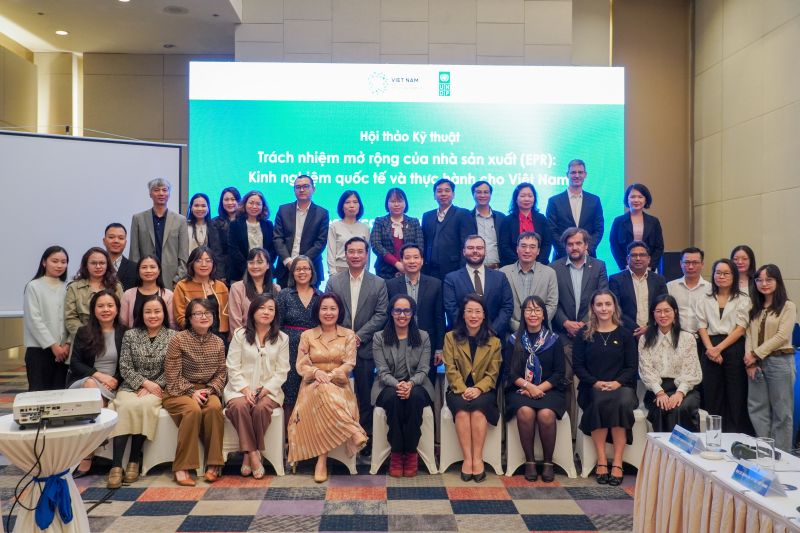

This morning in Ha Noi, government agencies, businesses, recyclers, industry associations, academic institutions and development partners came together for the Technical Consultation for a Functional Extended Producer Responsibility (EPR) System in Viet Nam, co-organized by UNDP in Viet Nam in collaboration with the Vietnam Environment Agency through the Viet Nam National Plastic Action Partnership (NPAP).
More than two years into the implementation of EPR under the 2020 Law on Environmental Protection, the consultation provided a platform to discuss practical solutions to strengthen the system’s effectiveness.
📌 Session 1: Global and Regional Insights
International experts shared experiences from different EPR models and highlighted practical lessons for policy design and implementation:
• Governance approaches enabling high recycling and recovery rates in Canada (presented by Ms. Madeleine Myhill, MEB – Waste Resource Policy Analyst & Mr. Ben Routledge, LLAg., M.A. – Manager of Solid Waste Services)
• Connecting EPR systems to verified environmental impact frameworks (presented by Ms. Vigil Yangjinqi Yu – Senior Program Officer, Verra)
• Operational models with regard to Producer Responsibility Organizations (PROs) (presented by Ms. Anke Boykin – Senior Director of Global Environmental Policy, PepsiCo)
• Policy design lessons from the Philippines’ EPR implementation (presented by Mr. Jepp Parales – Senior Specialist, Environmental Management Bureau, Department of Environment and Natural Resources (DENR) of the Philippines)
Moderated by Mr. Vinh Hoang (UNDP Programme Analyst), the open discussions underscored that effective EPR systems require strong governance, reliable data systems, and close collaboration across the value chain.
📌Session 2: Revising Viet Nam’s EPR Regulation
The second session focused on technical discussions around Articles 54 and 55 of the Law on Environmental Protection, which define recycling obligations and financial contributions for waste treatment. Participants exchanged perspectives on key areas for improvement, including:
• Sharing proposed revisions to the articles (presented by Mr. Thuan Do Xuan – officer from EPR Office of MAE)
• Clarifying responsibilities for producers and importers
• Enhancing monitoring, verification, and compliance mechanisms
• Improving transparency in the management and use of financial contributions
The consultation reiterated the importance of learning from early implementation experiences while aligning with global best practices. These dialogues are an important step toward a more effective EPR system and a stronger circular economy transition in Viet Nam.
#EPR #CircularEconomy #NPAPVietNam